Monday, 23 June 2025

TRAGEDY, ZINEDINE AND VIERA

23rd June 1968
On this day, a tragedy occurred in Argentina at the end of a local derby between River Plate and Boca Juniors, played at the El Monumental Stadium in Buenos Aires. As the fans left the ground after the 0-0 draw, one of the exit gates was found to be closed, trapping those at the front of the growing queue from behind. Fans further back weren’t aware of the problem at the gate and continued to push towards the exit, crushing those fans at the front. Tragically 71 fans died and over 150 others suffered injury in the ‘Tragedy of Gate 12’. It all sounds very familiar doesn’t it – if only lessons could have been learned! 

On this day, in 1972, Zinedine Zidane was born, 53 years ago. He played 108 times for France and scored 31 international goals. 

Zinedine Zidane
Zidane in 2017
Personal information
Full nameZinedine Yazid Zidane
Date of birth23 June 1972 (age 53)
Place of birthMarseille, France
Height1.85 m (6 ft 1 in)
Position(s)Attacking midfielder
Youth career
1981–1982AS Foresta
1982–1983US Saint-Henri
1983–1987SO Septèmes-les-Vallons
1987–1989Cannes
Senior career*
YearsTeamApps(Gls)
1989–1992Cannes61(6)
1992–1996Bordeaux139(28)
1996–2001Juventus151(24)
2001–2006Real Madrid155(37)
Total506(95)
International career
1987–1988France U16
1988–1989France U174(1)
1989–1990France U186(0)
1990–1994France U2120(3)
1994–2006France108(31)
Managerial career
2014–2016Real Madrid Castilla
2016–2018Real Madrid
2019–2021Real Madrid
*Club domestic league appearances and goals

Zinedine Yazid Zidane was born on 23 June 1972 in La Castellane, Marseille. He is the youngest of five siblings. Zidane is of Algerian descent, and his parents, Smaïl and Malika, immigrated to Paris from the village in northern Algeria in 1953 before the start of the Algerian War. The family, which had settled in the city's tough northern districts, found little work in the region, and in the mid-1960s moved to the northern Marseille suburb of La Castellane. In an interview with Esquire magazine, he stated:

I have an affinity with the Arabic world. I have it in my blood, via my parents. I'm very proud of being French, but also very proud of having these roots and this diversity.

His father worked as a warehouseman and security guard at a department store, often on the night shift, while his mother was a housewife. The family lived a reasonably comfortable life by the standards of the neighbourhood, which was notorious throughout Marseille for its high crime and unemployment rates. Zidane credits his strict upbringing and his father as the "guiding light" in his career.

It was in Castellane where Zidane had his earliest introduction in football, joining in at the age of five in football games that the neighbourhood's children played on the Place Tartane, an 80-by-12-yard plaza that served as the main square of the housing complex. At the age of ten, Zidane got his first player's licence after joining the junior team of a local club from Castellane by the name of US Saint-Henri. After spending a year and a half at US Saint-Henri, Zidane joined SO Septèmes-les-Vallons when the Septèmes coach Robert Centenero convinced the club's Director to get Zidane. Zidane stayed with Septèmes until the age of 14, at which time he was selected to attend a three-day training camp at the CREPS (Regional Centre for Sports and Physical Education) in Aix-en-Provence, one of several such footballing institutes run by the French Football Federation. It was here that Zidane was spotted by an AS Cannes scout and former player Jean Varraud, who recommended him to the training centre director of the club. As a 14-year-old watching the 1986 World Cup, the performance of Maradona left an indelible mark on him, with Zidane stating Maradona "was on another level".

Patrick Viera was also born on this day in 1976.


Sunday, 22 June 2025

JUNE 22 1986

Two of football's most famous World Cup goals were scored in a five minute spell on this day in 1986, when Maradona showed the World both sides of his personality in the World Cup quarter-final in Mexico City. Maradona claimed his first goal which was helped by the "hand of God", whereas the English Press saw it as "the hand of the Devil" as post-Falklands relations were a little "gritty" at the time. Just to rub it in, Maradona then skipped past five England players, scoring one of the greatest goal ever seen. Video Below!

https://www.youtube.com/watch?v=Da_CDPRG2j0 and more fun......

In the 1974 World Cup, the first rounds of qualifying were from Groups of four. Zaire was the first black African nation to qualify for the tournament and had lost 0-2 to Scotland in their group on June 14th and then 0-9 to Yugoslavia on June 18th. Their final group game was against holders, Brazil on June 22nd!! Zaire defender, Mwepu Llunga, got a little excited in this memorable match (for him!) when waiting for a Brazilian free-kick and this happened...see below!


Brazil, having drawn with Yugoslavia 0-0 and Scotland 0-0, needed to beat Zaire by 3 clear goals to qualify and Brazil scored after 12 minutes, surprisingly their first of the tournament having drawn 0-0 with Yugoslavia and 0-0 with Scotland. Indeed, Brazil did win 3-0 in Gelsenkirchen. Goals from Jairzinho, then Rivelino gave them hope and with 11 minutes to go a speculative shot from Valdormio seemed to be covered by the keeper, who jersey was obviously slippy and the ball squirted into the net. 

Brazil then did get through the next qualification, in Group A, beating East Germany and Argentina 2-1, but lost to Cruyff's Holland 0-2. 
In Group B West Germany qualified with three wins against Poland, Sweden and Yugoslavia and beat Holland in the Final 2-1. Brazil lost the Third Place play off 1-0 to Poland in front of 79,000 at the Olympic Stadium, Munich. 
West Germany beat Holland 2-1 in the Final, played at the Olympic Stadium, Munich. A crowd of nearly 78,000 saw this live and reputedly, a 1000 million viewed it on TV. England's Jack Taylor was the referee, who awarded Holland a penalty after less than a minute without a German player touching the ball!!! when Cruyff was brought down by Hoeness. Neeskens scored, the first successful penalty in a World Cup Final! There was second penalty awarded to the Germans  after 25 minutes, following a poor tackle by Jansen on Holzenbein. Breitner scored. It was, the German centre-forward, Gerhard Muller's last international match.
Wolfgang Overath added the Winners' medal to his collection of a Runners-up medal and a Third Place medal! The only man to have collected all three!

Saturday, 21 June 2025

FRANCO TO ARTHUR HOLLAND

General Francisco Franco forbade his national football team, Spain, to play a match against USSR in the first ever European Championship in 1960. The Soviets went on to win the tournament, beating Yugoslavia (on the 21st day of June) 2-1.

The tournament in 1964 was marred by political tension, Greece withdrew without playing a match after refusing to take the field against Albania. This time Spain, as hosts of the tournament, would not back out and the reached the Final, where they found the USSR opponents. Franco was there to witness the clash.  

Spain were not allowed to field their great, naturalised Hungarian players, Laszlo Kubala and the very famous Ferenc Puskas, but they did have midfielder Luis Suarez, who in 1960 was the first and only player at the time, to win the European Footballer of the Year award. 

Spain's route to the final
RoundOppositionScore
Preliminary roundRomania6–0 (h), 1–3 (a)
Round of 16Northern Ireland1–1 (h), 1–0 (a)
Quarter-finalRepublic of Ireland5–1 (h), 2–0 (a)
Semi-finalHungary2–1 (aet) (neutral)

In the quarter-finals, Spain beat the Republic of Ireland 7-1 on aggregate over two  legs and then won the semi-final with an extra time goal from Amaro against the very talented Hungary, which later would be a bit "special" in the 1966 World Cup.

75,000 watched in the pouring rain at the Santiago Bernabeu Stadium for the match they might have played four years previously. Spain went on to beat the Russians 2-1 to win their first European trophy. Jesus Maria Pereda, scored after six minutes to make it 1-0 but Khusainov equalised soon after and Spain hung on till the 83rd minute when Martinez headed a winner past the very famous Russian, keeper, Lev Yashin. Of course, Franco used the victory as a symbol of his Fascist Regime's superiority over Communism!

En route to the final, Spain defeated Romania, Northern Ireland and the Republic of Ireland over two legged ties, before beating Hungary in the semi-finals. The Soviet Union received a bye in the qualifying round, before beating Italy, Sweden and Denmark en route to the final. Spain won the Final, 2–1 to earn their first European Championship title.

The Referee for the Final, played in front of an attendance of 79,115 spectators, was Arthur Holland from England. 

Below, Referee, Arthur Holland (1916 - 1987) looks on as West Ham United Football Club team captain Bobby Moore (1941 - 1993) and Nobby Lawton (1940 - 2006), team captain for Preston North End Football Club shake hands before the kick off of their FA Cup Final match on 2nd May 1964 at Wembley Stadium in London, United Kingdom. West Ham United won the game 3 - 2.

Referee Arthur Holland
Born26 November 1916
Barnsley
DiedMarch 1987
Barnsley
He worked as a miner from 1935 and after his refereeing retirement as a publican, running The Paddy public house in Kendray, Barnsley.
International FIFA Referee 1959-64


Friday, 20 June 2025

WIN OR DIE

On this day, the Italian dictator, Benito Mussolini, brought a new motivation to his national football team when it was due to play Hungary in the 1938 World Cup final. 

Mussolini saw the match as an opportunity for national "posturing". Il Duce sent "his" World Cup players a telegram which read "Vincere o morire". This you will see means "Win or Die". Well of course he could have been "teasing" but many took him seriously. Whatever, it did the trick and the Azzuri won 4-2 and the Hungarian goalkeeper, Antal Szabo after the match said, "I may have let in 4 goals, BUT I saved their lives!!"

1938 FIFA World Cup final
Italy are champions
Event1938 FIFA World Cup Final
Date19 June 1938
VenueStade Olympique de Colombes, Paris
RefereeGeorges Capdeville (France)
Attendance45,000

Thursday, 19 June 2025

WORLD CUP, WEST MIDLANDS, WEMBLEY, WHOOPS!

On this day (18th June) in 1966, at the England World Cup Finals, one of the shocks of the tournament was North Korea's 1-0 defeat of Italy at Ayresome Park, sadly now only Middlesbrough's old ground. That victory saw North Korea qualify for the Quarter-finals at the expense of the Italians!! 

On this day (ditto) in 1982, Doug Ellis (remember him? ever heard of him?) became chairman of Wolverhampton Wanderers, saving the club from extinction. Previously, Ellis had a stint as Aston Villa chairman and had been on the Birmingham City board...keeping it in the Midlands! He later rejoined the Villains, thinking he might be the "answer" to any worries about West Midlands football.

On the 18th of June 1996 etc, England recorded an impressive 4-1 win over Holland at Wembley to reach the quarter-finals of the Euro 96, Alan Shearer and Teddy Sheringham (the SAS strike force!!) scoring two apiece. The late goal scored by Holland also saw them through to the last 8, at the expense of Scotland! Sorry!

On June 18th 2002, you guessed it... it was the turn of South Korea to record a famous World Cup victory over the Italians. At the last 16 knock-out stage, South Korea, who co-hosted the 2002 finals with Japan, progressed to the quarter-finals with a 2-1 victory over Italy with the winner being an extra-time golden goal scored by Ahn Jung-hwan. Ahn played his club football in Italy with Perugia - well he did until the next day!!! when the the Perugia owner cancelled his contract  saying 'I have no intention of paying a salary to someone who has ruined Italian football'. 

South Korea beat Spain on penalties in the quarter-finals before losing to Germany in the semis and then Turkey in the 3rd/4th place play-off.

Tuesday, 17 June 2025

SWEDES 2 TURNIPS 1

On this day in 1992, there was another England failure when Gary Lineker's career ended after 48 international goals, one short of Sir Bobby Charlton's national record. It was Lineker's last cap, playing in a do or die match against Sweden in the European Championships. Lineker was substituted by national manager Graham Taylor, a gamble that misfired for Taylor and he was "lambasted" in the national press following his team's failure. The Sun as you would expect ran the headline "Swedes 2 Turnips 1" putting Taylor head on the obvious parts of the forementioned turnip vegetable! See below.

1992 European Championship The populous was not convinced about Taylor's appointment as our national manager. From his appointment, England lost just once in Taylor's first 23 matches, this the 1–0 defeat to Germany at Wembley in September 1991. However, England struggled to qualify for EGuro 92. In a group containing Turkey, Ireland and Poland, England were held to two 1–1 draws by Ireland and managed just 1–0 wins home and away against Turkey. It was only a late goal from Gary Lineker, against Poland that saw England qualify at Ireland's expense. England's qualification for the Euro 92 finals proved to be the high point of Taylor's tenure.

The number of players that Taylor was using in the run up to the championship was also questioned, the press and public viewed this as evidence Taylor did not know his best team. He used 59 players in total, as he struggled to find a "new spine" after the retirement of Peter Shilton, Terry Butcher and Bryan Robson. He also faced accusations he could not cope with "stars", after he dropped Gascoigne for the less controversial Gordon Cowans, for a qualifying game against Ireland, fearing Gazza might "lose his head" in what would be a "bruising" encounter. Matters were not helped by Taylor's reluctance to use creative players who were not perceived to have high work rates, such as Chris Waddle and Peter Beardsley. He also suffered several injuries, notably to stalwart, Gary Stewart, Lee Dixon, John Barnes and Paul Gascoigne, leaving the squad in a makeshift position going into the finals.

England were drawn to face France, Denmark and hosts Sweden in Group 1. In the opening game against Denmark, England started brightly and missed several chances to take a lead. Platt was guilty of a particularly glaring miss. Thereafter, Denmark began to dominate the match, and nearly won with minutes left as John Jensen struck a post. The game ended 0–0. In the match against France, Platt nearly scored with a diving header which went inches wide of the post, and Stuart Pearce hit the bar with a free-kick. The game also ended 0–0.

England needed to beat hosts Sweden to advance to the semi-finals. Lineker crossed for Platt to open the scoring on four minutes with a mishit volley. However, England wasted several chances to extend their lead. Platt made a pass to Tony Daley who wasted a chance to pass to Lineker in the open. England held a slender 1–0 lead at half-time. After half-time, Sweden changed their personnel and formation, and dominated the second half, scoring twice to win 2–1......eliminating England.

During the game, after 60 minutes and with the score at 1–1, Taylor substituted Gary Lineker in his final game for England, preventing Lineker from having the chance to equal, or possibly break, Bobby Charlton's record of 49 goals for England. Many were dismayed to see Taylor substitute England's top striker when his side needed a goal. Taylor was vilified, including the "turnip" campaign by The Sun, which began the morning after the game under the headline: "Swedes 2 Turnips 1". During that campaign, the newspaper's back page featured an image of Taylor's face superimposed onto a turnip.

On 24th November 1993. Taylor died suddenly and unexpectedly from a "suspected heart attack" at his home early on the morning of 12th January 2017. Aged, 72. His funeral was held nearby, on 1 February at St Mary's Church, Watford, with many football figures in attendance.

Lincoln City
Watford
Aston Villa: Second Division Runners-up: 1987-8, First Division Runners-up: 1989-90


Monday, 16 June 2025

GOALS, GOALS, GOALS!

Listening to Talksport, yes I know!! but it is half past four, so the "outdoor day" is done! I'm trying to find a subject for today's Blog....Here goes, the record for the most individual goalscorers in a single football match is 16. This occurred in the 1989-90 FA Cup semi-final replay between Crystal Palace and Liverpool. The match saw 16 different players score across both the original game and the replay, The first match ended in a 4-3 victory for Crystal Palace, with 9 different goalscorers. The replay then saw 7 different players score in a 3-3 draw, bringing the total to 16! 

The 2007-8 Premier League match between Portsmouth and Reading, on 29 September 2007, set a record as the highest scoring match in Premier League history. The match was played at Fratton Park (yes, Pompey's home) on 29 September 2007. Eleven goals were scored in the match, leaving a final scoreline of 7–4 in Portsmouth's favour. This included six goals during the last twenty minutes of the match, including two scored in injury time. 

Portsmouth7–4Reading
Benjani  6', 37', 70'
Hreiðarsson  55'
Kranjčar  75'
Ingimarsson  81' (o.g.)
Muntari  90+2' (pen.)
ReportHunt  45'
Kitson  48'
Long  79'
Campbell  90+4' (o.g.)

Did the 20,000+ crowd stay to the end???

The highest score recorded in a first-class BRITISH football match is 36. This first occurred in the Scottish Cup match between Arbroath and Bon Accord when Arbroath won 36–0 on their home ground in Arbroath, Scotland, UK on 12 September 1885. We should know this, and yes I have mentioned it before on here. 

The feat was later equalled in an Estonian Cup match between Infonet FC and Virtsu Jalgpalliklubi, with Infonet FC winning 36–0 at the Lasnamäe KJH Stadium in Tallinn, Estonia, on 13 June 2015.  This Estonian Cup game pitted the Premier League side from the national capital against a non-league side from a small town of just 500 people. Fair? Infonet FC, also known as FCI Tallinn, was a professional football club in Estonia. It was founded in 2002 and merged with Levadia Tallinn in 2017, forming FCI Levadia. Infonet achieved promotion to the top-tier Meistriliiga in 2012 after winning the Esiliiga. They also won the Meistriliiga (league) title in 2016. The club's history includes a record-equalling victory in the Estonian Cup in 2015, defeating Virtsu 36-0. 

But for the lack of nets in the Arbroath game  (note the date) and the consequent waste of retrieval time, the score must have been even higher. Seven further goals were disallowed for offside. Arbroath’s huge win held the record for the most goals scored in a match for 117 years until the record was eventually beaten by AS Adema and SO Emyrne in 2002. These two teams played in the Madagascan top flight - the THB Champions League - and they destroyed the record! SO Emyrne won the THB Champions League in 2001. 

A 149–0 scoreline was recorded in Madagascar in 2002, but all the goals were own goals as part of a protest. This match holds the record for the most "own goals" in a football match.These two teams played in the Madagascan top flight - the THB Champions League - and they destroyed the record! SO Emyrne won the THB Champions League in 2001. 

2002 was to be AS Adema’s year. Before this match was played, AS Adema had already wrapped up the title after a draw for SO Emyrne, in their penultimate match saw them concede defeat in the title race. A controversial late penalty was given against them in that game, which was undeniably a debatable call by the referee. Of course, given the ramifications, the club wasn’t so happy with the decision and decided to stage a protest in their final game against champions, AS Adema. Amazingly the SO Emyrne players from THEIR kick-off passed the ball back into their own net. CHECK THE LAW ON WHAT HAPPENS TO THE KICK OFF WHEN A TEAM CONCEDES AN OWN GOAL! The ball must pass forward, a circumference, from the kick off...but after....?
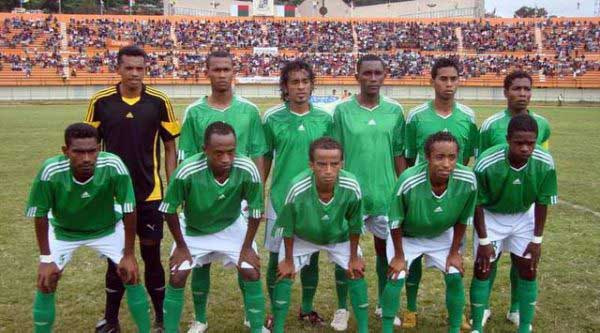
Madagascan football team SO Emyrne line up in their green jerseys ahead of a match.

 SO Emyrne was responsible for the most goals in a football match, with 149 own goals. Unsurprisingly, by the time the referee blew the final whistle, the game had smashed the record for most goals in a match by a country mile, ending with a win to the home side. The silly stunt cost the SO Emyrne coach, as well as four players (including the Madagascan national team captain) their jobs. The National Football Association handed out three-year bans to each of them.