Saturday, 22 June 2019

WHERE THERE'S MUCK THERE'S BRASS

The Hepworth Juniors that I was privileged to look after today were playing at the annual Honley FC 6 a side tournament. Honley is nestled in the Holme valley on the way to Huddersfield. We had an emotional afternoon playing through our qualifying group, three games and getting four points which carried the U9s through to the knock out stage. This ground to a halt against Raistrick Junior FC, but only on penalties and the young men (note no girls) were worn out and disappointed not to go further.

Raistrick has a population of  around 11,000...hardly village size. The "village" supports a cricket team which I have been past on many an occasion sited at Round Hill, the highest point in the area.
There is of course a Raistrick Junior FC but not a serious senior club.

Brighouse, the name coming from Bridge House (on the Calder River), with a population of over 32,000, hosts the senior football team . The town sits on the Calder navigation, a canal that hooks up many points in West Yorkshire, vital for the transportation of goods, especially wool and coal around the region.

More famous is the Brighouse and Raistrick Brass Band that people of my age will remember getting to number 2 in the "Record Charts" with "The Floral Dance"-I think Terry Wogan had a bit of a do with them also. The record stayed there for 6 weeks.
The band was founded in 1881 (when the Old Carthusians won the FA Cup) and was known originally as the Temperance Band-no booze?
Who knows any brass player who doesn't like a beer or two?
The band won the first ever World Brass Band Championship in 1968 and has been National Brass Band Champions and Euro Champs on many occasions.

The Brighouse football team is well established having its origins in 1963 and its Juniors from 1989 and there is a Ladies section too. The Town seniors have worked their way through the pyramid staring off as a works club for the Blakeborough Valve Company. The company eventually closed in 1988 but the club carried on and has found itself in the Northern Premier  League Division One. Their best FA Vase performance was in 2012-13 making it to Rd 4. In the squad at the moment are Elliot Kebbie from Sierra Leone. Danny Facey from Grenada and a Welsh John Price.
Brighouse Town F.C. logo.png

Friday, 21 June 2019

HAGI AND SON

Shirt badge/Association crest
England's U21s have to beat Romania's youngsters to qualify for the next stage of the UEFA Euro competition.
The Romanians qualified through their group by bettering Portugal, Bosnia, Wales, Switzerland and Lichenstein. The have just beaten a useful Croatia 4-1 at San Marino on June 18th, so they are no mugs.

One player in the squad is Ianis Hagi, the 20 year old son of Romania's most well known international Gheorghe Hagi, who strutted his stuff in the 1980-90s. Father played 125 games for his country and over 500 games for a variety of clubs, most successfully at Real Madrid, Barcelona and lastly at Galatasaray. His first class goalscoring tally was 237. Many belters-see below.
Image result for hAGI
In 2009, Gheorghe founded Viitorul Constanta and managed a club based at Ovidui, a town near Constanta, playing and being very successful, in the nation's Liga 1.
Nickname? Pustii Lui Hagi-Hagi's Kids! If any can play like him!!! He was voted the 25th best footballer out of 100 by the World Soccer magazine.
Ianis Hagi 2015 (cropped).JPG
Ianis started at Steaua Bucharest in 2007, went to his father's academy, one of the largest in Europe
until 2014, joined father's Viitorul Constanta until 2016, played briefly for Fiorentina (2 matches) and now is back at Viitorul
https://www.youtube.com/watch?v=EfjYTYWE1FQ  MUST WATCH

On the national rosta is Alex Pascanu who plays for Leicester City (or is at least on their books).
FC Viitorul 2017 badge.png

Thursday, 20 June 2019

LA ALBICELESTE

British sailors were most likely to carry any new commodity from Europe to the rest of the World, and of course materials on the way back, along with ideas and kit from overseas.
British sailors would take footballs with them to relieve the boredom on board ship and to play football near their docked vessel. They would of course bring back goodies from far and wide (beef?).
In South America, ships on the great trade triangle would entertain themselves in a variety of ways, one of those by playing a game of football on a flattish beach or quayside.

In the 1860-70s foreign capital and immigrants poured into Argentina particularly around the River Plate estuary, playing an important part in developing agriculture and railways. Two young Yorkshiremen from Skelton, formed a football team to relieve the commitment to the city's commerce and banking in Buenos Aires.

On June 20th 1867, James and Thomas Hogg, with close friend Walter Heald, organised the first official match played on the continent. The wool trade brought the Yorkshire lads to the country, once it had won its independence from Spain. Father Thomas, owned a textile mill in Yorkshire and having set up a business in Argentina, he became an important expatriate in Buenos Aires, helping set up a commercial centre and British Library, along with a cricket club which left the locals bewildered.
 
Son, Thomas, above, formed the Dreadnought swimming club in 1863 and brother James organised the Buenos Aires Athletic Society in 1867. They both set up the first rugby match that took place at the cricket club in 1974. Needless to say a golf course followed-the first in Latin America and then tennis got an airing.

Thomas was giving a copy of the newly formed FA Laws (1963) in 1867 and soon the game was evolved along side rugby. The founding committee included the "Skelton" brothers, Thomas Jackson from Cumberland, Thomas Barlow Smith from Stoney Middleton (Derbyshire) and Walter Heald from Pendle, a good northern spread.

The first pitch used happened to be a field planted in alfalfa but they had to carry their goalposts from place to place using a vacant field and made sure that the local English newspapers got wind of their initiative. One such field happened to be in the residential area, La Boca; you know the rest.

On June 20th 1867 the first authentic football match took place on Argentina's National Flag Day and bank holiday at the Buenos Aires Cricket Club in Palermo suburb. As history reveals, only English football and the formation of the Sheffield FC pre-dates this event and the date is closely  matched by the founding of Queen's Park in Glasgow.
Shirt badge/Association crest International football did not get going until the start of the 20th Century although the Scottish tea magnet, Sir Thomas Lipton, presented a trophy to be played for between Argentina and Uruguay

The participants had to review the wearing of shorts in front of "ladies" but soon played an 8 a side game involving all Brits except for William Boschetti who had been born in St Lucia.
The Rojos (reds) wore red caps of course and the Blancos white. Score 4-0 to Rojos made up from two Hogg brothers and friends. The game developed slowly for a while but circumstances, such as an economic crash, the "social" popularity of rugby caused by the variation in "rules" introduced from England, the spread of yellow fever (killed over 26,000) , civil war and more unrest prevented a rapid development of the game. The rich of course preferred less "working class" activities.
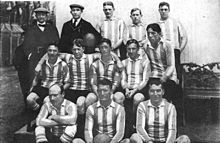
v Uruguay 1908 La Albiceleste (the sky blue and whites)

Wednesday, 19 June 2019

THE CRUYFF TURN AND NO FLAGS

The 1974 World Cup West Germany.
The Dutch's first group match was orchestrated by Cruyff, who got things going with his skillful play against Uruguay on June 15th. The game ended in a 2-0 win. The South Americans took no prisoners and were well organised in defence, brutal to be honest. Rep scored two, Uruguay were reduced to 10 men after Castillo punched Rensenbrink in the stomach.
40 years after first playing in the World Cup, the Dutch won their first tournament game.

June 19th 1974 Westfalenstadion Dortmund: Holland v Sweden Score 0-0.
43 years ago
Four days later there was this disappointing 0-0 draw, despite the Dutch being inspired by Cruyff but his team mates could not score. It was not a game devoid of skill however.

Johann Cruyff sent Jan Olsson for a "hot dog" with a skill now known as the "Cruyff Turn". Johan, under the care of manager Rinus Michels, was a crucial part of the revolutionary "Dutch Total Football" system. It was 43 years ago and their brand of football was very much a pleasant shock to the system. The Dutch side was made from a squad of players who apparently could play anywhere on the pitch (probably not the goalkeeper).
https://video.search.yahoo.com/yhs/search;_ylt=AwrCwCR.Twpd0GEAiAQPxQt.;_ylu=X3oDMTB0N2Noc21lBGNvbG8DYmYxBHBvcwMxBHZ0aWQDBHNlYwNwaXZz?p=the+cruyff+turn+1974&type=ckyolo-tg061719%3A%3AdGhlIGNyeXV5ZmY%3D%3A%3AdGhlIGNyeXV5ZmY%3D%3A%3At&hspart=pty&hsimp=yhs-pty_extension&param1=20190206&param2=59a55b3e-4583-462f-a572-add7d7bd1d00&param3=template_%7EGB%7Eappfocus1&param4=d-ccc2-lp0-dsf_template--bb8%7EChrome%7Ethe+cruyff+turn+1974%7E6618CE2CC373E957E627A33B5BFCB3D0&ei=UTF-8&fr=yhs-pty-pty_extension#id=1&vid=32c0d7d59c09c1f6878c20c216b121f3&action=view
 On June 23rd, Johan's team beat the Bulgarians 4-1 with Neeskens 2, Rep and de Jong scoring, coming top of the group.
They then went on to play in another group set up with their gears well oiled. Here they beat Argentina 4-0, with Cruyff scoring two and making one and then beat East Germany 2-0 and lastly Brazil by the same score.

Inevitably they became favourites to win it overall. They met West Germany in the Final on July 7th in Munich. This was the final with no corner flags, noticed by English referee Jack Taylor.

A minute later Taylor awarded the Dutch a penalty when Cruyff was brought down by Hoeness, with no German touching the ball; Neeskens scored. Remember this was in Germany! Brave Jack. Breitner equalised with another penalty after 25 minutes.

The "fox in the box" Muller scored before half time, making a tally of 14 in the tournament, beating France's Juste Fontaine's record. It was Muller's last international match.

There was no further goal and the Final became known as the first Final to have no goal scored in the second half.

Wolfgang Overpath collected his third WCup medal, gaining one of each; A winners, runners up and third placed. The (West) Germans had last won the World Cup in 1954.


Tuesday, 18 June 2019

INTERNATIONAL ISLAND GAMES

The XVIII Nat West International Island Games 2019 will be held on Gibraltar, the only bidders. Though the Island cannot support all the sports, it is hosting a number of competitions and other events are "spread around"! Football for example is being held unofficially on Anglesey-Ynys Mon because The Rock doesn't have enough pitches! The island hopes to host the 2025 games.
There is a range of sports, most rare is 10 PIN bowling, but favourites include athletics, triathalon judo and squash and MORE.

This IIGA biannual event will take place between July 6-12th. So excited are we, that Her Majesty's Government Philatelic Bureau is publishing a set of commemorate stamps to recognise the occasion. The mascot shown above is known as HOPE; no doubt plastics come into the occasion!

Yes these stamps are belters! There was a LIVE DRAW for the Table Tennis....over 2200 competitors will take part in over 200 events from 14 sports. The Hassans International Law firm will be a Platinum sponsor for the games and the University of Central Lancashire will provide medical and sports' therapy during the games. Golf has been held in every games since 1997 but this year there is none-NO COURSE!
First held on the Isle of Man in 1985, 700 competitors from 15 countries turned up. Two years later on Guernsey, numbers increased and more recently the games have been held in Bermuda (2013), Jersey (2015) and on in 2017 in Gotland.
You may turn to your Globe or Atlas and have a lesson: find Aland, Froya, Saaremaa, the Falklands and of course the Isle of Wight.
Football champs are the Isle of Man who beat Greenland 6-0 in Gotland in 2017.
Accommodation ranges from school rooms to a cruise ship which bunks 3,000.

Gibraltar Island Games Association Logo
Gibraltar Island Games Association LogoGibraltar Island Games Association Logo

Monday, 17 June 2019

PUNJAB UNITED CURRY FAVOUR

From Indian/Pakistani football yesterday to PUNJAB UNITED today, it could not be better! You think I plan all this don't you? By chance, tonight on BBC1 at 7.30 is a documentary about Punjab United FC and the club's rise through the pyramid.

Chipie is the central force behind the success, a local business man, Jugjit Singh Sian, has invested his money and time into forming an open club, at Elite Venue, Gravesend, Kent.  Supported by his brother Jindi, friends Navin, Harry and Jaswinder, the club has risen through the pyramid. It is a club that is open to all, making moves of course towards the Asian fraternity, but anyone can join.
In the past football was not in the Asian culture, parents were not "available" to run kids to practice or matches and there were distractions such as cricket!! Girls/women would hesitate to join in and football was just not in their culture. But things are changing with trials, teams, transport and clubs much more available.

Can you name ten Asian footballers playing in the Leagues?

So this drama is "warts and all" with Chipie leading the way to explaining how the club functions.


Forming in 2003 the club played in the Kent Combination League and reached the Premier League in 2016. They won the League in 2016-17 with a record number of points, were victorious in the Kent Intermediate Cup and were runners up in the Kent Challenge League Cup.
They moved up to Step 6 into the Southern Combination East League coming 17th/20. Next they play in Step 5 Southern Counties East League and then into the Isthmian.
The club hosts a Reserve side and a Youth team too.


Sunday, 16 June 2019

INDIAN FOOTBALL

India v Pakistan has been an electric cricket fixture for decades and today they meet at Old Trafford to renew their rivalry.
This is in cricket of course and in football the two have met and it has been full on but hardly "world class".

Unofficial football was played by India, pre-Independence, with unofficial internationals against Ceylon (0-1 win) in 1933 and China (1-1). The national development was spurred on against foreign opposition with some English encouragement, forming the All India Football Federation in 1937.

There was an Australian tour post independence, playing State sides from New South Wales, Victoria, South Australia and Northern Districts. The tour began in August 1938 and on September 3rd 1938 India played Australia in Sydney losing 5-3. The Indians stayed in Australia until October playing a variety of opposition from State teams to town teams such as Ipswich. A later tour visited Australia, Japan, Indonesia and Thailand.

The national side (above) played in the London Olympics in July 1948, losing to France only 1-2. In preparation the team played barefooted against teams from:
"The Department Store XI" won 0-15, Met Police 1-3, Pinner 1-9, Hayes 1-4, Alexander Park 2-8, Isthmian League XI 1-3 and Welsh amateur sides.

In 1950 the national team withdrew from the World Cup tournament, the reason not being allowed to play without boots!

Since the end of the war various English managers have taken over the coaching; Harry Wright in 1964 a goalkeeper from Charlton,  in 1982 the aptly named Bob Bootland took over and more recently, Steve Constantine who did two spells in 2005-7 and 2015-19 and Bob Houghton (once of Malmo 1979 European Cup Finalists) from 2006-11.
Joe Kinnear of Ireland had a spell in the post in 1983!
The team ranks 101st in FIFA and this summer has had a full fixture list from commitments to the Asian Cup v UAE and Bahrain, the King's Cup in June beating Thailand 1-0 and losing to Curacao  1-3. In July they meet Thailand, North Korea and Syria in the Intercontinental Cup.

Matches against Pakistan have been sporadic, much depending on the tournaments provided. They have met India 24 times only, Pakistan winning 3 and drawing 10 games. India very much on top.

Pakistan football in FIFA is less powerful, ranked 205th. The first official international was in 1950 against Iran losing 1-5.
Today's squad includes Samir Nabi from Torquay Utd, Rahi Nabi at Alvechurch and Tabish Hussain playing at Guiseley.
George Ainlsey was the national coach in 1959-62, having previously coached Cambridge University AFC.
You will find Bert Trautmann, the German goalkeeper, on the coaches list (1980-3), David Burns a half-Dutch FA coach in 2000-1 and John Layton from Hereford United 2001-2 and ex-Spurs Graham Roberts 2010-11.
Shirt badge/Association crest