Tuesday, 7 June 2022

ITS THE GERMANS

Tonight an England plays Germany in the UEFA Nations League Group A3, away at The Allianz Arena. By all accounts the Germans have as many issues with injuries as Gareth does! However, Germany are unbeaten in 10 games since Hansi Flick became top coach, following England's defeat of the Germans at Euro 2020. It would be fun to reproduce the 5-1 victory for England in Munich, 2001, when Michael Owen scored a hat trick; however, Germany ended up in the World Cup Final, England didn't. 

On 18 April 1897, an early international game for Germany was played in Hamburg, when a selection team from the Danish FA defeated a selection team from the Hamburg-Altona FA 5–0. In the 1899-01 era there were five unofficial friendlies played, all ending in large defeats for the Germans.

The Germany national football team the Deutsche Fußballnationalmannschaft or Die Mannschaft, played its first official match in 1908. Matches were played against "Germany" from 1930.

Between 1949 and 1990, separate German national teams were recognised by FIFA due to Allied Occupation and Division. The German team representing the Federal Republic of Germany, (named West Germany from 1949 to 1990); the Saarland Team representing the Saar Protectorate (1950–1956); and the East German team representing the German Democratic Republic(1952–1990). The present team represents the reunified Federal Republic. The official name and code "Germany FR (FRG)" was shortened to "Germany (GER)" following the reunification in 1990.

Germany has won World Cups in 1954 (then West Germany), 1974, 1990, 2014, three European Championships 1972, 1980, 1996 and one Confederations Cup 2017  They have also been runners-up three times in the European Championships, four times in the World Cup, and a further four third-place finishes at World Cups. East Germany won Olympic in 1990. Germany is the only nation to have won both the FIFA Men's and Women's World Cup. At the end of the 2014 World Cup, So there is some pedigree.

The Germans played their first international as the DFB against Switzerland in April 1908 in Basel. In 1920 the Swiss were the first opposition for the post 1st World War German side and again in 1950 the Swiss were chosen to bring the Germans back into the footballing fraternity after World War 2. In 1990 the German side including the new East German Association also played the Swiss, once the "wall came down".

The official historic England results list shows the Germans winning 15 matches and England 14, with 4 draws, surprisingly only 33 games between the two.

The first official engagement was May 10th 1930, in The Deutsches Stadium, with a 3-3 draw in Berlin. Job Mutters reffed and 60,000 watched. Joe Bradford (below) of Birmingham City scored 2 and David Jack of Arsenal, the other.

Next England hosted them in 1935, winning 3-0. By 1938, national captain Eddie Hapgood and the heroic Stanley Matthews were amongst a reputedly strong English side to meet the Germans in Berlin again, a nation under Hitler's control. The players were "told" by an FA Official, Charles Wreford Brown (an Old Carthusian), to acknowledge the German leader by giving the salute before the match. 140,000 watched this episode as Nazi Germany showed off and then England "showed off" by thumping them 6-3. This was belittling for Hitler and later, on the same sports' field, his "super race" also were shown up at the Berlin Olympics by the black American athlete, Jesse Owens. Another story!

By 1938, Austria became part of Germany under the Anschluss (the annexing of Austria into Nazi Germany) and since the Austrians at the time were a major force in European football, the Germans benefited from this injection of talent. However it did not help in the 1938 World Cup, as the Germans lost on aggregate to Switzerland...there they are again!

England and "Germany" met again in 1954 but by this time it was West Germany. England won 3-1 with Len Shackleton, Roy Bentley and Ronnie Allen scoring in front of 100,000 at Wembley.
Since then, there have been regular fixtures with World Cup ties in 1966 (Final! 4-2 win), 1970 Germany won 3-2, 1982 (Draw 0-0), 1990 (Draw 1-1), 2000 (England 0-1 Germany) and recently there have been friendly games in 2016,  2-3 to England and 2017, 0-0 and on June 29th 2021, England won 2-0 in the UEFA Championship.

Monday, 6 June 2022

ENGLAND ABROAD ESPECIALLY AFRICA

England's first international was against Scotland, away at Partick, on November 30th 1872. 

There were then annual matches against the "Home" nations, at The Oval, firstly, a  2-1 win v Wales in 1879 and then a debut by Ireland at the Knock Ground, Belfast, in 1882 (England won 13-0). By 1908 European opposition was taken in during "demonstration" tours to Austria (6-1 and 11-1), Hungary (7-0) and Bohemia (4-0). Belgium were at home in 1921, a 2-0 win for England, France at home, a 4-1 win and Sweden in Stockholm, a 3-1 win in 1923, v Luxembourg (5-2) in 1927 and Spain in 1929 where there was a 3-4 loss in Madrid. 

In 1930, it was the Germans in Berlin 3-3, Italy 1933, Czechoslovakia 1934 (lost 1-2). Holland in 1935, Norway (won 6-0) and Finland ((won 8-0) 1937, Switzerland 1938 ((lost 1-2), Yugoslavia 1939 ((lost 1-2), Portugal 1947 ((won 10-0) and then the Brazilian World Cup in 1950, eventually as the English FA eventually agreed to join in the Global fun, 20 years late!!

Brazil hosted 1950 World Cup Finals and England met Chile on June 25th, their first match against a South American country, winning 2-0. England also met USA for the first time (loss 0-1) and Spain (loss 0-1) in their group. They did not "go on" to the next phase.

The first time England played an African nation (apart from South Africa), was in January 1986 v Egypt in a Cairo friendly ((won 4-0). Then on June 6th it was against Morocco in a group match at the 1986 World Cup finals in Monterrey, Mexico. There was a disappointing 0-0 draw, marked by the first sending off of an England player in a World Cup finals match, when Ray Wilkins threw the ball at Paraguayan referee, Gabriel Gonzalez. England qualified from the group in second place with group winners Morocco becoming the first African nation to qualify for the knock-out stages.

Savages FC (Pietermaritzburg, South Africa), and Gezira SC are the oldest African football clubs that remain in existence. Both began play in 1882 followed by Alexandria SC (1890), CDJ Oran from Algeria in 1894 and CAL Oran from Algeria too in 1897.

1909-10 The Football Association Tour of South AfricaAn 18-man squad left Southampton on May 7th for the 17-day voyage to South Africa, where they embarked on a 23-match tour, spanning nine weeks. Nine of the squad had previously played in full internationals (though one withdrew after two games because of injury and another player then joined the squad), whilst another two went on to win full caps. THis was a "demonstration" tour......

26 May 1910 - Western Province 1 England 7  Cape Town, British Cape Colony (3,000)
Holley (3), Fleming (2), Duckworth, Raine 
The first match of the tour, just two days after the visitors' arrival, saw the Football Association XI take on a team restricted to those born locally in the British colony, which was about to be unified with the three other British colonies to form the Union of South Africa, five days later.

28 May 1910 - Western Province 0 England 13 Cape Town, British Cape Colony (3,000)                                    Hibbert (6), Berry (3), Woodward (2), Wedlock, Holley

1 June 1910 - Griqualand West 0 England 2 Kimberley, Cape Province    Wall, Hibbert

4 June 1910 - Griqualand West 1 England 7 Kimberley, Cape Province     Hibbert (3), Fleming (2), Berry (2)

8 June 1910 -Orange Free State Province 0 England 4  Bloemfontein, Orange Free State Province                                                                                                                                              Hibbert (2)Woodward, Wall

11 June 1910 - Johannesburg 1 England 6    Wanderers Ground, Johannesburg (5,000)                                         Woodward, Wall (3 (1 pen)), Fleming, Holley 

13 June 1910 - West Rand 1 England 3    Krugersdorp, Transvaal Province Wall, Raine, Fleming

15 June 1910 - Pretoria 1 England 4  Pretoria, Transvaal Provincenk    Hibbert (2)Wedlock, Holley

18 June 1910 - Transvaal Province 0 England 1    Wanderers Ground, Johannesburg  Hibbert

20 June 1910 - Klip River 3 England 13  Ladysmith, Natal Province Hibbert (6), Raine (3), Holley (2), Wedlock, Wall

22 June 1910 - Pietermaritzburg 0 England 6  Natal Province Holley (3), Hibbert (2)Wedlock

25 June 1910 - Natal Province 2 England 6 Durban  Berry (3), Woodward (2)Hibbert

29 June 1910 - South Africa 0 England 3  Durban, Natal Province (5,000) Hibbert

2 July 1910 - Cape Frontier 0 England 7  East London, Cape Province Wall (3), Fleming (2), Woodward (2)

4 July 1910 - Cape Frontier 0 England 6 King William's Town, Cape Province Fleming (3), Woodward (2), Raine

6 July 1910 - Port Elizabeth 0 England 8  Port Elizabeth, Cape Province  Hibbert (3), Woodward (2), Duckworth, Berry, Holley

9 July 1910 - Eastern Province 0 England 10 Port Elizabeth, Cape Province Woodward (3), Fleming (3), Hibbert (3), Richards

12 July 1910 - Grahamstown 0 England 9 Grahamstown, Cape Province Holley (3), Woodward (2), Wedlock, Raine, Berry +?

16 July 1910 - Rand League 1 England 2  Wanderers Ground, Johannesburg, Transvaal Province
Woodward, Fleming

20 July 1910 - East Rand 0 England 5  Vogelfontein, Transvaal Province Woodward (3), Holley (2)

23 July 1910 - South Africa 2 England 6  Wanderers Ground, Johannesburg(13,000) 
Fleming 
(2)Woodward (2), Wall, Holley

27 July 1910 - Western Province 0 England 9  Cape Town, Cape Province Woodward (2), Fleming (2), Raine (2), Silto, Hibbert, Sharpe

30 July 1910 - South Africa 3 England 6  Cape Town, Cape Province (5,000)  Holley (2)Woodward (2)Fleming, Berry: with seven full internationals in the side, plus a future cap, managed to complete their fixtures with a hundred per cent record, before the long journey home and the start of the new football season.


Sunday, 5 June 2022

LIONS PASSANT GUARDANT

Faversham Town Football Club is based in Faversham, Kent. Nicknamed the 'Lilywhites' due to their white strip, they are currently members of the Isthmian South East Division and play at Salters Lane. Due to the fact that Faversham's civic coat of arms is based on the Royal Arms of England. Faversham Town is the only English club side to have a badge depicting three lions, passant guardant, similar to the England national team.

The club's origins go back to 1884, and they entered the Kent League for the first time a decade later. The club name however was not really consistent, with the team turning out as Faversham Town, Faversham Invicta, Faversham Services, Faversham Railway and Faversham Rangers among others before being disbanded shortly before the Second World War.

Faversham Town reformed after the war and entered the Kent League in 1947. The club moved to its 
current home - Salters Lane the following year. There were some years of success and others withn little to write home aboput!! Matters reached crisis point in 2003, when the Kent County FA suspended the club for non payment of fines, with the club's operators blaming just about everyone for the mess except themselves. In the following months, the once proud Salters Lane ground was systematically wrecked by vandals. Meanwhile, club trustees led by businessman Ray Leader fought a desperate battle to heal a widening rift with the previous regime over the ownership of the club and ground.Kent County FA allowed the club to retain their coveted senior status subject to several conditions. Local authority grants were applied for and secured, sponsorship deals obtained, and the club embarked on a range of fund raising initiatives. Slowly but surely, Salters Lane was returned to its former glory, before the future became even brighter with the erection of brand new floodlights. The revival of club and ground from the "jaws of death" was nothing short of a miracle 


Saturday, 4 June 2022

JUNE 1988

International football is in the air. England are warming up for European competition and they will be hoping for a better preparation than in 1988, which clearly did not help our nation prepare for a serious competition, Whose idea was this? The FAs?

On 4th June 1988, before setting off to the European Championships in Germany,England played a warm-up match against the mighty…..Aylesbury United. England beat the Southern League champions 7-0 but not surprising, didn’t do as well in Germany – they found the opposition was a little better than Southern League standard and lost all three matches.

Prior to this, in 1988, England drew four internationals; three friendlies against Israel 0-0 in Tel Aviv; The Netherlands 2-2 at Wembley; Hungary in Budapest 0-0, Colombia 1-1 at Wembley, AND beat Scotland at Wembley 1-0,  The Scots and Colombia played England in the Rous Cup, named after Sir Stanley Rous, once the top man in  the FA. Finally there was a friendly against Switzerland in Lausanne, which England won 1-0.

In the European Championship Finals FIRST Rd, England lost to Ireland 0-1 on June 12th, The Netherlands, three days later 1-3, USSR 1-3 on the 18th. These were 1st Round games. SO Bobby Robson's team did not qualify!! P3 W0 D0 L0 F2 A7 NIL Points!

On  top of this embarrassment, in Dusseldorf before the Dutch game there were riots in the streets and 130 arrests. The good news was that Peter Shilton won his 100th cap, following Bobby Moore, Bobby Charlton, and Billy Wright. 

England team v The Netherlands: Shilton, Stevens, Samson, Adams, Watson, Steven,Webb, Robson, Barnes, Beardsley, Lineker (subs: Wright, Hoddle, Hateley). Lineker and Adams scored.

Prime Minister Thatcher, pushed her identity card scheme, using events in Germany to her political advantage. 

The rest of the year resulted in a friendly win over Denmark at home 1-0; a 0-0 v Sweden at Wembley which was a World Cup qualifier and another thumping 1-1 draw with Saudi Arabia in Riyadh 1-1. Lineker who had featured in the five of these games had not scored. His form and England's inertwined.

In  this year (1988) England scored 9 goals in 12 games. Goalscorers: Lineker 3,  Adams 3, Beardsley 1, Robson 1, Webb 1. On the bright side England conceded only 11 goals!

Friday, 3 June 2022

1908 MATCHES IN JUNE

FIFA was founded in May 1904, in Paris, but the England FA representatives did not offer their country as a joining member, leaving the continentals, Denmark, France, Netherlands, Spain and Switzerland to form their own "association". The FA seemed to think that their association was "above" the rest and hence international football was being protected. From 1904 England's only international challenges were from the "home" countries, Ireland, Scotland and Wales, usually towards the end of the league season in February, March and April.  

The England football team did not play any matches in June until in 1908, when the England international team played its first match in June on the 6th, during their first European tour. Four matches in early June two against Austria and none against Hungary and Bohemia were meant to be an advertisement for the game, "invented by the  English". With football very much in its infancyhe England team totalled 28 goals for, against 2! The tour squad shown below with their opposition, travelled between June 6th to the 13th, in Vienna, Budapest and Prague.

https://gameofthepeople.com/2014/08/26/the-pioneers-englands-1908-european-tour/ is the reference for the notes below.

Thjis was a period when England could claim to be “masters of the footballing universe”. Understandably, there was not a lot of well organised football being played in Europe! This was largely because the game in the United Kingdom had evolved faster than in other European countries, there could be little doubt that England were far advanced of their neighbours across the English Channel. This view would be strengthened in 1908 when England went on a summer tour to central Europe and later in the year, Great Britain would scoop the gold medal in the longest Olympic Games on record."

The full squad was: Goalkeeper – Horace Bailey (Leicester F); Full backs – Bob Crompton (Blackburn), Jesse Pennington (WBA); Half backs – Walter Corbett (Birmingham), Robert Hawkes (Luton), Ben Warren (Derby), Billy Wedlock (Bristol City); Forwards – Jock Rutherford (Newcastle), Jimmy Windridge (Chelsea), Vivien J Woodward (Tottenham), George Hilsdon (Chelsea), Frank Bradshaw (Sheff W), Arthur Bridgett (Sunderland).

slavia prague

Austria were no competition for England and in the first meeting on June 6 at the Cricketer Platz in front of 3,500 people, they ran out 6-1 winners. Hilsdon and Windridge scored doubles and Woodward and Bridgett netted one apiece. The speed of the England forwards was too much for a pedestrian Austrian back line. Two days later, at the Hohe Warte stadium, England bettered that scoreline to win 11-1.Woodward grabbed four and Bradshaw three. The other goals were scored by Warren, Bridgett, Rutherford and Windridge. Almost half the Austrian side played for sides from Bohemia.

The team moved on to Budapest and on June 10, they beat a Hungarian side drawn almost exclusively from Budapest sides. They won easily 7-0, with Hilsdon scoring four (plus goals from Windridge, Woodward and Rutherford). Interestingly, the referee was Hugo Meisl, who would later become the manager of the Austrian “Wunderteam”.

This really was a whistle-stop tour and on June 13, they travelled to Prague to play Bohemia at the Stadion Letna in front of the biggest crowd of the trip – some 12,000. The Bohemia side comprised 11 Slavia Prague players (pictured). This time England won 4-0 with goals from Hilsdon (2), Rutherford and Windridge. That was it, the tour was over, but a year later, England returned to central Europe where they did it all over again. They left an impact on local football folk, though, and when they returned to the region, the crowds were more than double 1908 levels.

There was another tour in 1909 in Hungary (2 matches) and Austria, but these were hardly a challenge with 20 goals for and 5 against, as the FA were treating the tour as an advertisement for the game, which they intended to become a World phenomenon-it worked, eventually.

Thursday, 2 June 2022

UKRAINE INTERNATIONALS ABROAD

 The Ukraine has been in the news recently for obvious reasons. This information below covers the geographical arrangements of the country's more successful internationals and the clubs they have migrated to, to earn a living. Their national team has just beaten Scotland 3-1 in a World Cup qualifier.

THE UKRAINE INTERNATIONAL SQUAD AT JUNE 2nd 2022:      


No.        POS           NAME                            DOB                          CAPS/GOALS    CLUB

12          GK            Andriy Pyatov (captain) 28 June 1984 (age 37)  101/0      Shakhtar Donetsk

1            GK           Heorhiy Bushchan 31 May 1994 (age 28) 14/0                  Dynamo Kyiv

              GK            Andriy Lunin       11 February 1999 (age 23) 6/0       Spain Real Madrid

23          GK            Dmytro Riznyk   30 January 1999 (age 23) 1/0                 Vorskla Poltava

22           DF           Mykola Matviyenko        2 May 1996 (age 26)  48            Shakhtar Donetsk

21           DF           Oleksandr Karavayev     2 June 1992 (age 30)  41             Dynamo Kyiv

2             DF           Eduard Sobol     20 April 1995 (age 27)   27               Belgium Club Brugge

16           DF           Vitaliy Mykolenko    29 May 1999 (age 23)  22         England Everton

13           DF           Illya Zabarnyi      1 September 2002 (age 19)   19         Ukraine Dynamo Kyiv

19           DF           Taras Kacharaba    7 January 1995 (age 27) 1       Czech Rep Slavia Prague

3             DF           Valeriy Bondar  27 February 1999 (age 23)   1/0               Shakhtar Donetsk

   DF           Denys Popov     17 February 1999 (age 23)   1/0               Dynamo Kyiv

4             DF           Oleksandr Syrota    11 June 2000 (age 21)     1/0               Dynamo Kyiv

7             MF         Andriy Yarmolenko         23 October 1989      107/45   England West Ham

6             MF         Taras Stepanenko            8 August 1989 (age 32) 70/4        Shakhtar Donetsk

17           MF         Oleksandr Zinchenko     15 Dec  1996 (age 25)  49/8  Eng  Manchester City

5             MF         Serhiy Sydorchuk             2 May 1991 (age 31) 48/3           Dynamo Kyiv

8             MF         Ruslan Malinovskyi          4 May 1993 (age 29) 46/6     Italy Atalanta

15           MF         Viktor Tsyhankov             15 Nov 1997 (age 24) 36 /6         Dynamo Kyiv

10           MF         Mykola Shaparenko        4 October 1998 (age 23) 24/1       Dynamo Kyiv

20           MF         Oleksandr Zubkov           3 August 1996 (age 25)   19/1   Hungary Ferencváros

14           MF         Mykhaylo Mudryk           5 January 2001 (age 21) 1/0          Shakhtar Donetsk

18           MF         Oleksandr Pikhalyonok  7 May 1997 (age 25)        0/0          Dnipro-1

9             FW         Roman Yaremchuk          27 Nov  1995 (age 26)     37/13 Portugal Benfica

11           FW         Artem Dovbyk   21 June 1997 (age 24)                    7/3          Dnipro-1

   FW         Danylo Sikan 16 April 2001 (age 21)                       4/1  Germ Hansa Rostock

The country has a population of just over 44 million, and  the name Ukraine "borderland"; a map will show you why! and might also explain why Russia is giving it a hard time. Needless to say, these young footballers (some a little older) are in great demand and have spread their wings into the far reaches of Europe; note not into any other continents! 

Ukraine is among the poorest countries in Europe and suffers from widespread corruption according to various international monitors. However, due to its extensive fertile land, pre-war Ukraine was one of the largest grain exporters in the world. It is a member of the UN, the Councilo of REurope and four other supportive "councils", whilst possibly also coming under Russia's wings! with 17% of the population Russian.

Many Ukrainians also played for the Soviet National team, most notably Ballon d'Or winners Ihor Belanov and Oleh Blokin. This award was only presented to one Ukrainian after the dissolution of the Soviet Union, Andriy Shevchenko. The national team made its debut in the 2006 FIFA World Cup and reached the quarterfinals before losing to eventual champions, Italy. Ukraine come 27th in FIFAs rankings, England 5th. Next fixture on the 5th v Wales in a WCup qualifier and then the ROI on the 8th in the Nations League.

Wednesday, 1 June 2022

THE LOWRY, TERRY, LAWRIE AND MORE

June 1st 2009 was the UK Premier of the Eric Cantona movie "Looking for Eric" shown at the Lowry Centre, Salford Quays, Manchester. Eric played himself and the most memorable line was "I am not a man-I am Cantona".

Two years earlier (2007), John Terry played an unusual role at the newly rebuilt Wembley, when he scored England's only goal against Brazil in front of nearly 89,000. It looked like a victory at one point but Diego equalised in "added" time. It w.as the first game to be played at the "new" stadium.

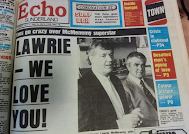
At the end of the 1971-2 season, when fans invaded the pitch after Grimsby Town won the Fourth Division Championship, their manager, Lawrie McMenemy, made a speech to the crowd in an attempt to restore order. As soon as Lawrie finished his speech a lad in the crowd, threw away his crutches and cried "It's alright Lawrie, I can walk now!". The lad strutted off, others gawped at the miracle and Lawrie enveloped a "God-like aura"! 
Actually Lawrie knew the lad and knew the child had been on the mend previously. Lawrie moved to the south coast, from Grimsby in the Summer of 1973 and within 3 years guided the Second Division  club, Southampton to winning the FA Cup (remember Bobby Stokes' goal v Man U?). The Saints were then promoted, were runners up in the 1979 League Cup, he signed Kevin Keegan from Hamburg in 1980 and then came runners up in the League behind a rampant Liverpool in 1983-4. 
In 1985, Lawrie decided he had done his work at Southampton and he moved to his "north-east" and Sunderland. 

He did not have the success that he hoped for, despite spending money on Eric Gates, George Burley and Ray Kennedy. 
With the club, one point above the relegation zone, the local lads vandalised his gold Mercedes in March 1987 and he resigned. A month later, Sunderland lost their final league game to Barnsley 2-3 having been 2-0 up and missing a penalty. Needing a win, they then lost the relegation play-off to Gillingham and Sunderland dropped into the Third Division for the first time in history.

On June 1st 1958, Scotland played their first ever international match against Poland in Warsaw. So almost a perfect coincidence, but at least 8 of the 11 Poles had a "k" in their name and no Scot was called "Mc" or "Mac"!! The Macs won 2-1. A bloke with a "k" in his name scored the Poles' goal. 

TODAY Wales are playing Poland away in the Uefa Nations League....presently 0-0!