Monday 26th October 1863
ON THIS DAY 163 years ago, English football's governing body, the Football Association, held its first meeting, making it the oldest national football association in the world. The Football Association, English football’s governing body, was formed in 1863. ‘Organised football’ or ‘football as we know it’ dates from that time.
Remembering Mr. EBENEZER COBB MORLEY (Born 16 August 1831 – Died 20 November 1924), acclaimed English Sportsman and is regarded as the Father of the Football Association and modern Football, on his Birth Anniversary today. Ebenezer Morley, a London solicitor, founded Barnes FC in 1862. Morley became captain of the Barnes Football club and in 1863 he wrote a letter to Bell's Life newspaper proposing a governing body for football. Ebenezer wasn’t a Public School man, but old boys from several Public Schools joined his club and there were ‘feverish’ disputes about the way the game should be played. Morley wrote to Bell’s Life, a popular newspaper, suggesting that football should have a set of rules in the same way that the MCC had them for cricket. His letter led to the first historic meeting at the Freemasons' Tavern in Great Queen Street, near to where Holborn tube station is now.
Twelve clubs sent representatives to the meeting, held at Freemasons' Tavern on Long Acre, Covent Garden, London, in order to agree on a common set of rules. The clubs were Barnes, Civil Service, Crusaders, Forest of Leytonstone, No Names Club (Kilburn), Crystal Palace, Blackheath, Kensington School, Percival House (Blackheath), Surbiton, Blackheath Proprietary School, and Charterhouse (who declined the offer to join).
Prior to the creation of the Football Association, football clubs in England operated under different sets of rules, including the Cambridge Rules, used by many clubs throughout the nation, and the Sheffield Rules, which dominated the game in the northeast. Although those two sets of rules contained slight differences, they both prohibited hacking (imagine that!!), which would prove to be a point of contention for the new FA.
Indeed, when the FA ultimately adopted a set of rules that closely mirrored the Cambridge Rules, several clubs chose to form a separate Rugby Football Union that allowed hacking. Thus the Football Association was instrumental in triggering the split between association football (or "soccer") and rugby.
The FA currently oversees all association football competitions in England and is in charge of the English men's and women's national teams. As the first football association in history, it is the only one not to include its nationality in its name.
.
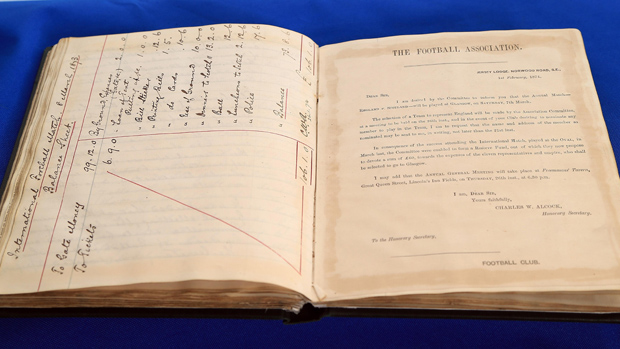
The captains, secretaries and other representatives of a dozen London and suburban clubs playing their own versions of football met “for the purpose of forming an Association with the object of establishing a definite code of rules for the regulation of the game”.
Note: *Civil Service FC, who now play in the Southern Amateur League’s Senior Division One, are the only surviving club of the eleven who signed up to be FA members at that first meeting in 1863, when they were listed as the War Office. NOTE: Civil Service FC celebrated their 150th anniversary in 2013. *This club has no connection with the present Premier League club.
There could be no authority without laws and six meetings took place in 44 days before the new Association could stand on its own feet. The FA was formed at the first. Its rules were formulated at the second. (There was an annual subscription of a guinea and alterations to rules or laws were to be advertised in sporting papers.) A useful discussion on drafting the laws took place at the third meeting.
‘Football’, they thought, would be a blend of handling and dribbling. Players would be able to handle the ball: a fair catch accompanied by ‘a mark with the heel’ would win a free kick. The sticking point was ‘hacking’, or kicking an opponent on the leg, which Blackheath FC wanted to keep!!
The laws originally drafted by Morley were finally approved at the sixth meeting, on 8 December, and there would be no hacking. They were published by John Lillywhite of Seymour Street in a booklet that cost a shilling and sixpence. The FA was keen to see its laws in action and the first "official" match was played between Barnes and Richmond at Limes Field in Barnes under the new Laws, on 19 December. It was a 0-0 draw! Too many laws??!!


