Thursday, 9 November 2023

HERRERA-Il Mago

Herrera's Last Departure

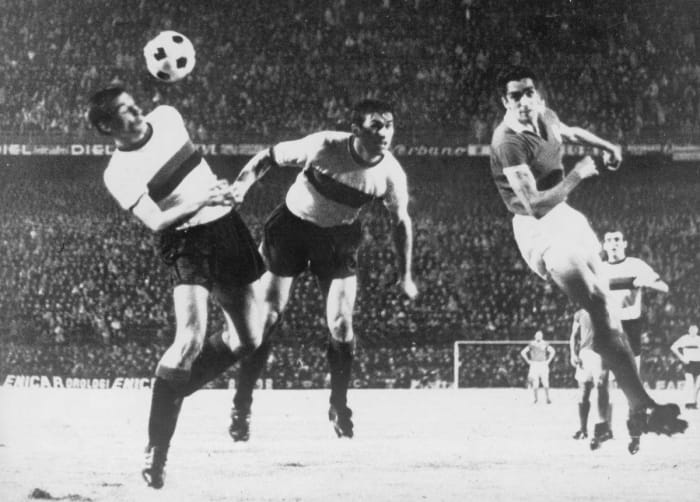
On 9 November 1997, 87-year old Helenio Herrera died in Venice from heart failure. Nicknamed "Il Mago,"  the Magician. Herrera is remembered chiefly as one of the chief architects of catenaccio, the defensive strategy that helped Inter claim two European Cup trophies.
Herrera was born in Argentina to Spanish parents, but moved to Morocco at the age of four where he became a French citizen. He started his playing career in Morocco, but moved to Paris in 1932 and played for a number of French teams. In 1944, he joined Puteaux for one season as a player-manager, then retired from playing in 1945.
After undistinguished stints at Stade Français (1945-48) and Real Valladolid (1948-49), Herrera took over at Atlético Madrid where he was an instant success, winning the league in his first two seasons. After his third season, however, he left and started a journey that took him to five different Spanish and Portugeuse clubs over the next seven years, including a successful period with Barcelona (1958-60).
In 1960, he moved to Inter, where he developed the style that made him famous. He used a 5-3-2 formation called the verrou (Italian for "door bolt"), which used four fixed defenders, plus a sweeper who patrolled the area between the defenders and the keeper and who was responsible for stopping anyone who made it through the defense. The formation also used the defensive back line to launch rapid counter-attacks.
Although the formation did not originate with Herrera, it became popular after the 1964 European Cup Final in which Inter defeated Real Madrid, 3-1. It was widely adopted in Italy and became known as catenaccio. 
The trailblazing Argentine revolutionised the art of coaching, implementing psychological techniques and professionalising his squads in an era that cared little for proper conditioning and preparation
Herrera left Inter in 1968, having won three league titles (1963, 1965, 1966), another European Cup (1965), and two Intercontinental Cups (1964, 1965). He retired in 1981.
european-cup-final-5cf3f5745fba3b0b4c000001.jpg


Wednesday, 8 November 2023

IF THE CAP FITS and Bambridge's exciting debut


In the early days of football, the concept of each team wearing a set of matching shirts had not been universally adopted, so each side would distinguish itself from the other by wearing a specific sort of cap. 
The practice was first approved on 10 May 1886 for association football after a proposal made by N. Lane Jackson , founder of the Corinthians: That all players taking part for England in future international matches be presented with a white silk cap with red rose embroidered on the front.

In sport, a cap is awarded for a player's appearance in a game at international level. The term dates from the practice in the UK of awarding a cap to every player in an international match of rugby union and association football. In the early days of football, the concept of each team wearing a set of matching shirts had not been universally adopted, so each side would distinguish itself from the other by wearing a specific sort of cap.

An early illustration of the first international match between Scotland and England in 1872 shows the Scottish players wearing cowls, and the English wearing a variety of school caps.

Edward Charles Bambridge (30 July 1858 – 8 November 1935) made eighteen appearances as a left winger for England between 1879-1887, being appointed captain twice. He was one of three brothers who played for England. He was an extremely fast winger, being considered one of England's first notable players. Throughout his career he was known as "Charlie Bam".

Charles Bambridge was born in Windsor, and his parents had been a missionary in Waimate. New Zealand and then the "official" photographer to Queen Victoria. Charles was educated at St Mark's School in Windsor and then Malvern College, Worcestershire and was a member of the college football team.

His football career was spent with Swifts and Windsor Home Park Streatham, Upton Park. Clapham Rovers and Corinthian, also gaining representative honours for Surrey, Berkshire and London.

He made his debut for England against Scotland at Kennington Oval, on 5 April 1879. At half time, England were 4–1 down to the Scots. Bambridge scored early in the second half and his teammates had levelled the score by the 75th minute. With less than ten minutes remaining, the Scots scored what they thought was the winning goal but the referee disallowed it as offside. The English forwards then raced upfield with Bambridge scoring the winning goal, thus enabling England to claim their first victory over the Scots since 1873 in what was described as "the most exciting England and Scotland game to date". He won 11 caps. He was a member of the Football Association committee from 1883 to 1886 and a member of the Corinthians original committee in 1882. He became honorary secretary of the Corinthians between 1923 and 1932.


and here is Billy Wright OBE, of Wolves and England, very much a footballer of "my generation". At 5'8", not what you would expect for a centre half/back. Today is not an anniversary for him BUT, since we are on CAPS, he earned 105 caps, the first Englishman to pass the century, a centre half and captain; long serving Wolves player. Wright also held the record for longest unbroken run in competitive international football, with 70 consecutive appearances, captaining them a record 90 times, including during their campaigns at the 1950, 1954 and 1958 finals. He also played 490 times for Wolves, scoring a modest 13 goals.

Martin Peters, another England international (67 caps and 20 goals) was born on this day in 1943. As we know, he scored a great goal in the 1966 World Cup Final. He died on December 21st 2019
.

Monday, 6 November 2023

TOMMY LAWTON-KEEN AND FEARLESS

Thomas Lawton (born 6 October 1919 – died 6 November 1996) was born in Farnworth near Bolton. Lawton's natural footballing ability earned him a place on the Bolton Town Schools team in 1930. He was picked by Lancashire Schools at the age of 13. Despite scoring a hat-trick in a trial game for England Schoolboys, he never earned a full England Schoolboy cap. 

At the age of 14, Tommy began playing for Hayes Athletic in the Bolton Senior League, and went on to score 570 goals in three seasons. He played amateur football at local Rossendale Utd before he turned professional at Burnley on his 17th birthday. The FA's rules meant he was unable to turn professional at a club until he was 17, and Lawton's grandfather rejected Bolton Wanderer's offer for Lawton to work as a delivery driver for two years before turning professional at the club. Lawton instead played as an amateur for local Rossendale Utd in the Lancashire Combination, scoring a hat-trick on his debut against Bacup.

He took up temporary work at a Tannery, and then joined Burnley as assistant groundsman after his mother rejected an offer from Sheffield Wednesday, as she objected to him travelling to Sheffield on a daily basis.

His potential as a footballer won him a £6,500 move to Everton in January 1937 and finished as the First Division's top-scorer in 1938 and 1939, helping Everton to finish as champions of the Football League in the latter campaign. League football was then suspended for seven full seasons due to the outbreak of war in Europe, during which time he scored 24 goals in 23 appearances for England whilst guesting for Everton and a number of other clubs. In November 1945, he moved to Chelsea for £14,000, and scored a club record 26 goals in 34 league games in the 1946–47 season.

In November 1947, he made a surprise move to Third Division club Notts County for a British record fee of £20,000. He helped the club to win promotion as champions in 1949–50, before he moved on to Brentford in March 1952 for a club record £16,000. In January 1953, Brentford appointed him player-manager, though he would only remain in charge for nine months. He joined Arsenal as a player in November 1953 for £10,000, where he saw out the remainder of his playing career. Despite losing much of his best years to World War 2, he scored 260 goals in 433 league and cup competitions in 14 full seasons in the Football League.

He had a promising start to his managerial career by leading Kettering Town to the Southern League title in 1956–57, but then only had two more seasons as manager, getting relegated with Notts County in 1957–58 and then relegated with Kettering Town in 1963–64. During the 1970s he struggled with debt and related legal problems, which were reported in the media as an example of a celebrated person having fallen from grace.

He scored 22 goals in his 23 England appearances over a ten-year international career from 1938 to 1948, including four against Portugal in May 1947, a match that England won 10-0 (Stan Mortenson also scored 4, Tom Finney one and even Stanley Matthews, usually a supplier, scored). 

He helped England to win two British International titles outright (1946–47 and 1947–48), and to share the Championship in 1938–39. He fell out of international contention at the age of 28 due to his contempt for the "academic" manager, Walter Winterbottom. He also decided to drop out of the First Division, and the arrrival of Jackie Milburn and Nat Lofthouse on the scene. As well as his England caps, he also represented The Football League XI and played in a special Great Britain XI against The Rest of Europe in 1947. His ashes are held in the National Football Museum, and he was inducted into the England Football Hall of Fame in 2003.

Lawton also played cricket for Burnley Cricket Club in the Lancashire League. He hit a six against both Learie Constantine and Amar Singha. He scored 369 runs in 15 completed innings for an average of 24.06.

He turned a football professional at Burnley at the age of 17 on wages of £7 a week. His grandfather attempted to negotiate a £500 signing-on fee on his behalf but was rebuffed after the club alerted Charles Sutcliffe, Secretary of the Football League, who informed them that any attempt to circumvent the league's maximum wage was illegal. Lawton scored in his first appearance since signing the contract after just 30 seconds, before going on to record a PERFECT hat-trick in a 3–1 win over Tottenham Hotspur, scoring a goal with either foot and one with his head.

In January 1937, First Division club Everton paid Burnley £6,500 to secure Lawton's services, and also gave his grandfather a job as deputy groundsman at Goodison Park; the fee was a record for a player under 21. The move to Everton made him a teammate of Dixie Dean. his boyhood idol, whom he was expected to gradually replace as first choice centre-forward. He later recalled that on his way to Goodison Park on his first day as an Everton player he was told by a tram conductor that "You're that young Lawton, aren't you? You'll never be as good as Dixie." 

Dean was finally rested on 13 February, which allowed Lawton to make his first team debut against Woilves at Molineux; the match ended in a 6–2 defeat, though Lawton scored a penalty. He spent the rest of the season at inside-left, with Dean at centre-forward, and ended the 1936-7 campaign with four goals in 11 games. He started the 1937-8 season in the Reserves, but was installed as first choice centre-forward in September after Dean was dropped for punching club secretary Theo Kelly (don't ask!). On the 2 October, Lawton scored the winning penalty in a 2–1 victory over Merseyside rivals Liverpool at Anfield. He ended the campaign with 28 goals in 39 appearances to become the Division's top scorer.

Everton had a young but highly effective team for the 1938-9 campaign, and Lawton was praised for the way he led the attack, Lawton scored 35 goals in 38 league games to finish as the division's top-scorer for the second successive season. However, in the summer he wrote to Leicester City, to request that the club buy him from Everton; it was reported that he reached out to Leicester as they were managed by Tom Bromilow, his former Burnley manager. Everton were fifth in the league and Lawton was the division's top-scorer with four goals when league football was suspended three games into the 1939-40 season due to the outbreak of WW2. Lawton later remarked that "I'm convinced that if it hadn't been for the War, we'd have won the Championship again, the average age of those players was about 24 or 25".

Stanley Matthews surmised that "Quite simply, Tommy was the greatest header of the ball I ever saw." Lawton was never booked throughout his career; as a centre forward that is remarkable.

As was common for footballers during the war, he also made guest appearances for a number of clubs besides Everton, including Leicester City, Greenock Morton, Chester City, Aldershot and Tranmere Rovers. He was called up to the British Army in January 1940, and his status as an England international saw him recruited to the Physical Training Corps and played for the British Army team and his Area Command team. He was posted in Birkenhead, which allowed him to frequently appear for Everton.

On Christmas Day 1940, he played for Everton against Liverpool at Anfield in the morning and for Tranmere Rovers at Crewe Alexandra in the afternoon. Explaining this later, he said, 'The Tranmere people came into the dressing room and asked if anyone wanted to play as they were two men short. I said, "Go on, I'll help you out." And I did.' In 1942 he scored a hat-trick for England in a 5–4 win over Scotland at Hampden Park. Later in the year he scored six goals for Aldershot in a 9–0 win over Luton. On 16 October 1943, he scored four goals in an 8–0 victory over Scotland at Maine Road.

Chelsea- July 1945, Lawton handed in a transfer request at Everton as he wanted a move to a Southern club so as to see more of his increasingly estranged wife. In November 1945, he was sold to Chelsea for a fee of £14,000. Chelsea continued to play regional wartime fixtures as national league football had not resumed for the 1945-6 season, and Lawton also continued his uncapped appearances for the England national team. In the summer of 1946, following his demobilisation, he coached for the FA in a summer camp in Switzerland. However he struggled to settle at Stamford Bridge and came into conflict with manager Billy Birrell after refusing to go on a pre-season tour of Sweden in 1947, which resulted in him requesting a transfer. Chelsea eventually allowed him a move to Arsenal.


In November 1947, Lawton was sold to Notts County, in the Third Division South for a British Record fee of £20,000 (equivalent to £832,500 in 2021). He made the surprise decision to drop down two divisions so as to be reunited with manager Arthur Stollery, his former masseur and friend at Chelsea, and because he was promised a job outside of football upon his retirement by vice-chairman Harold Walmsley. He scored two goals on his home debut, a 4–2 win over Bristol Rovers in front of 38,000 spectators at Meadow Lane – a huge increase on previous home games of typically 6,000 to 7,000 supporters. He ended the 1947-8 season with 24 goals in as many games, though was resented by the club's directors after he insisted on pay rises for his teammates and stopped the practice of director's friends and family travelling to away games on the team coach.

County finished in mid-table despite scoring 102 goals, 15 more than champions Swansea. Lawton turned down the role as player-manager.  and Lawton finished as the division's top-scorer with 31 goals in 37 league games in the 1947-8, as County won promotion as champions. 

By 1950-1 Lawton was losing his form and he joined Second Division Brentford in March 1952 for £16,000. In January 1953 Lawton was appointed as player-manager, however he lost the dressing room due to his excessive demands of the players, and the strains of management were having a negative impact on his form. Brentford also lost their best players having sold both Ron Greenwood and Jimmy Hill. 

In November 1953, Lawton was traded to First Division champions Arsenal for £7,500. However Lawton was limited to ten appearances in the 1953–54 campaign after picking up an injury on his debut. He also played in the 1953 Charity Shield match, scoring one goal as Arsenal (League Champions) beat Blackpool (FA Cup Winners) 3–1.  On the opening day of the 1955-6 season, he announced his decision to leave Arsenal to pursue a career in management eight games into the campaign.

Lawton was called up to play for The Football League XI against a League of Ireland XI at Windsor Park on 21 September 1938, and scored four goals in what finished as an 8–2 win. A month later he went on to win his first cap for England on 22 October, England's first game of the 1938-9 Home International  season, a 4–2 defeat to Wales at Ninian Park and converted a penalty kick to mark his first England appearance with a goal. This made him the youngest player to score on his England debut, a record which lasted until Marucs Rashford broke it in 2016. Four days after Lawton's debut, he scored again for England at Highbury in a 3–0 win over 'The Rest of Europe', a team of players selected from Italy, Germany, France, Belgium, Hungary and Norway.

Newly appointed England manager Walter Wiunmterbottom played Lawton in England's first official match in seven years on 28 September 1946, a 7–2 win over Ireland. He played the remaining three fixtures of 1946, and scored four goals in an 8–2 victory over the Netherlands on 27 November.  On 10 May 1947, he scored two goals playing for the Great Britain XI in a 6–1 victory over a Rest of Europe XI that was billed as the 'Match of the Century'. Five days later he scored four goals in a 10–0 victory over Portugal at the Estadio Nacional. On 21 September, he scored after just 12 seconds in a 5–2 win over Belgium at the Heysel Stadium.

He retained his place in the England team following his club move to Notts County, and in doing so became the first Third Division footballer to represent England when he scored from the penalty spot in a 4–2 win over Sweden on 19 November. However he only won three further caps in 1948, his final appearance coming in a 0–0 draw with Denmark in Copenhagen on 26 September. He had become increasingly disillusioned with the England set-up, and told Winterbottom that "if you think you can teach Stanley Matthews to play on the wing and me how to score goals, you've got another think coming!" Winterbottom was also frustrated by Lawton's smoking habit, and preferred Jackie Milburn ahead of Lawton. Hopes of any future comeback were ended by the emergence of powerful centre-forward Nat Lofthouse who made his England debut in November 1950. His later life was not impressive and he had many financial issues. 

Lawton's health deteriorated in his old age and he died in November 1996, aged 77, as a result of pneumonia. His ashes were donated to the National Football Museum and he was inducted into the English Hall of Fame in 2003.

He starred alongside Thoora and Diana Dors in 1953 film The Great Game playing himself in a cameo role. Throughout the 1950s he went on to appear on What's My Line amongst other radio and television programmes. He published a total of four books: Tommy Lawton's all star football book (1950), Soccer the Lawton way (1954), My Twenty Years of Soccer (1955), and When the Cheering Stopped (1973).

Sunday, 5 November 2023

WHY IS A SPORT DERBY CALLED "A DERBY"?

My grandson, who has an interest in football (as well as other things!), ask me this question. WHY IS A SPORT DERBY CALLED "A DERBY"?

There are two thoughts!! One theory is that the phrase comes from the Derby horse race which was founded by the Earl of Derby in 1780. 


At a dinner party in 1778 held on his estate, The Oaks in Carshalton in, Lord Derby and his friends planned a sweepstake horse race, won the following year by Derby's own horse, Bridget. The race, The Oaks, has been named after his estate. At a celebration after Bridget's win, a similar race for colts was proposed and Derby tossed a coin with Sir Charles Bunbury, for the honour of naming the race. Derby won, and the race became known as the Derby Stakes. Bunbury won the initial race in 1780 with his horse, Diomed; Derby himself won it in 1787 with Sir Peter Teazle. His racing colours were black with a white cap. His influence on racing has been described as "crucial".

The Derby is held at Aintree, near both Liverpool and Everton’s football grounds. The two clubs grounds are at nearby Anfield and Goodison Park respectively.  These are famously separated only by Stanley Park, which was then owned by The Earl. Some believe the phrase originated from a match between Liverpool and Everton in 1914. The first match between the two Merseyside clubs was on 13 October 1894, so maybe the word, which involved two close competing teams from Merseyside. came from the horse race? It is the longest running top-flight derby in England and has been played continuously since the1962-3 season.

The other thought to the name's origin involves Shrovetide Football, an early, unofficiated version of both association and rugby football. It was a mob game, first played in the town of Derby prior to Medieval times. From as early as the 12th century, it was known to have been played in Ashbourne. It was a chaotic and exuberant affair that involved populations from each town, often resulting in fatalities.  The goals were at Nuns Mill in the north of the town and the Gallows' Balk in the south of the town, Much of the action took place in the River Derwent or the Markeaton Brook. (you will need a map!). Nominally the players came from the All Saints' and St Peter's church parishes, but in practice the game was a free-for-all with as many as 1,000 players, probably from anywhere!! Who ever fancied a bundle!  A Frenchman who observed a match in 1829 wrote in horror, 'if Englishmen call this play, it would be impossible to say what they call fighting'.   

Shrovetide football is still an annual event in the town of Ashbourne. Since at least as early as 1840 'derby' has been used as a noun in English to denote any kind of sporting contest. So maybe the Ashover event might hold the origin??? 

Friday, 3 November 2023

THE HORNETS VISIT OAKWELL

Tonight, I am off to Oakwell, yes the home of  The Tykes, Barnsley FC, who receive Horsham FC, the Isthmian League, Premier club, from the market town in West Sussex and my old club! In the 1947–48 season, Horsham reached the First Round Proper of the FA Cup for the first time on November 29th, taking a first-minute lead against Tommy Lawton's Notts County, before losing 9–1. It was my local club! and one that I played for when "younger"!

In 1966, I saw Horsham reach the First Round proper of the FA Cup for a second time, after defeating Hastings Utd (the South coast club including Bobby Smith, in semi-retirement after his "spell" at Spurs) 2–1 in the 4th Qualifying Round. I then saw Horsham played Swindon Town (including Don Rogers-remember him?) in front of a crowd of 7,134 at Queen Street. Although they lost 0–3, the day was a 'red letter day' for the club. A special temporary stand was erected at the Queen Street end of the ground for the match.

In 2006–07, the Hornets beat Maidenhead United 4–1, to reach the Second Round Proper of the FA Cup for the first time where two matches were played against eventual League One champions, Swansea City. 

2007–08 FA Cup run Horsham's FA Cup run started with a 7–1 defeat of Arundel in the 1st qualifying round and in the 2nd they came from 2–0 down to beat Bury Town 3–2. After a goalless draw at Kingsmeadow, Horsham then saw off AFC Wimbledon 5–4 on penalties in a 3rd qualifying round replay before booking their place in the First Round Proper for only the third time in their history with a 3–2 win at Chippenham Town. Horsham drew Maidenhead Utd of the Conference South, at home, in front of a crowd of 3,379, Horsham won 4–1 with goals from Nigel Brake, Lee Carney (2) and Lee Farrell, with Brake's long-range goal nominated in Match of the Day's goal of the month competition. 

Horsham then drew Swansea City in the 2nd Round, holding the then League One leaders to a 1–1 draw at Queen Street on 30 November 2007 when an 85th-minute penalty from Lewis Taylor cancelled out Gulliem Bauza's 41st-minute opener. Their replay at Swansea was played on 10 December 2007, the first ever FA Cup tie to be held at the Liberty Stadium, and a shock result was on the cards when Lee Farrell scored twice to put Horsham 2–1 ahead but Swansea recovered to win the tie 6–2. Both matches against Swansea were shown live on Sky Sports, the first time in the club's history that a match had been televised live. Record attendance: @ Queen Street: 7,134 v Swindon Town 26 November 1966 and @ the latest stadium, The Hop Oast 1,980 v Dorking Wanderers (FA Cup) 14 October 2023

I went to school in Horsham, to Collyer's School, now Richard Collier's Sixth Form College! It was a good football school, which in those days ran a full fixture card form U12 upwards at football and cricket (as well as other sports), playing on Saturdays (originally in afternoons and later morning kick offs) and Wednesday afternoons (our games' period on the timetable), later kick offs went to Saturday mornings. We travelled with four teams to Brighton, Chichester, and various towns within decent reach and four teams would travel to Horsham. 

So I have fond memories of learning my football with plenty of enthusiasm, from well intentioned and talented teachers. Ray Smith was most influential, who when I was in the Sixth Form and playing in his 1st XI. Ray was a Loughborough College graduate (wore the famous purple tracksuit!) and he played at Horsham FC and later at Lewes FC. I followed him through those two clubs and learnt a lot about playing at the adult level, originally in the Athenian League and later the Isthmian.

The Hornets, presently 7th in the league (P10 W6 D1 L3) have played Leatherhead in the FA Cup First Qualifying Round Sept 2nd (0-0 away) and winning 2-1 at home on September 5th. Then, they met Marlow at home 2-2 on Sept 16th, in the Second Q. Round and drew 2-2 at home, winning 1-3 away on Sept 19th.

The Third Qualfying Rd saw Horsham, at home, beat Hanworth Villa 3-1 on Sept 30th and in the Fourth Qual Rd 2-0 at home, beating Dorking Wanderers 2-0 on Oct 14th. Since then The Hornets have won 3 matches, two in the Non-League Premier and a 1-2 win away at Larkhall Athletic last Saturday (28th).

The Hornets next fixture will be on November 7th away at Chichester City in the Sussex Senior Cup and then at home to Hashtag United, back to normal in the Non-League Premier on the 11th.

The Camping World Community Stadium, Horsham FC

Today, the morning after the night before; seventh tier Horsham FC, from Sussex, earned a 3-3 draw at Oakwell in front of a 4,480 crowd, on a beautiful evening yesterday. The Tykes took an early lead through Watters after 14 minutes and fireworks lit up around Oakwell by neighbouring celebrations. Not a great start for the visitors.
The visitors', Shamir Fenelon equalised 8 minutes later and then the Hornets went ahead through James Hammond, who converted a penalty after 38'. Just before half time (actually after 45 + 1min) Soares Jalo managed another for the Tykes and it was left to the second half to produce a decider. Barnsley scored what we assumed would be a winner after 64' from de Gevigney. Horsham looked tired, but they raised their spirits and with 9 minutes to go, Tom Richards equalised for the Sussex club. The visitors had memories of past cup surprises. Dare I mention Notts County? have a look for FA Cup on November 29th 1947!
Match stats: Possession? Barnsley 54% Shots Barnsley 26 (13 on target) v 4 (3) from Horsham!! Corners B:12 H:1 Fouls B:12 H:4.
Happy evening!    https://www.youtube.com/watch?v=12Fn4SasvRA


Thursday, 2 November 2023

DEAR OL' ROY-SUCH A KEEN CHAP!

November 2nd: Roy Keane was on the "come back in" trail in 2002, when his suspension, for carving in half Alf-Inge Haaland, with an "X" rated tackle was lifted. The FA had to act after Keane's autobiography was published including an offending passage that read; "I waited long enough! I f*****g hit him hard, the ball was there (I think)! Take you you c*** and don't ever stand over me, sneering about fake injuries!"


Roy Keane – Career Low Points from Roy Keane-Bad Boy:

1995 – Sent Off for Diving ! In August 1995 Roy Keane was sent off while playing for Manchester United for the second time in a Premiership match against Blackburn Rovers for two bookable offences. The second yellow card was shown for diving. An unlikely event. (Source: Keane: The Autobiography – Page 153)

1995 – Keane’s Third Red Card in One Year

In October Roy was sent off for the third time in 1995 in a match against Middlesboro apparently, though unconfirmed, for punching a Boro player. (Source: Keane: The Autobiography – Page 153)

1996 – Roy Keane Sent Off in First Appearance as Irish Captain!!!

In March 1996 the Republic of Ireland played Russia in a friendly match at Lansdowne Road (now re-developed and named Aviva Stadium). Earning his 30th cap Roy Keane had been handed the Republic captain’s armband after Andy Townsend was substituted. Keane was “…sent off for kicking a Russian.” (Source: Keane: The Autobiography – Page 247)

1996 – Roy Keane Sent Off against Southampton

On 26th October 1996 Roy Keane was sent off for the fifth time in his career and for the third time in twelve months against Southampton at the Dell. Having been booked earlier in the match for dissent Keane went on to earn second yellow card for a late lunge on Claus Lundekvam. (Source: Keane: The Autobiography – Page 165)

1997 – Row With Neighbour over Straying Dog......dog answered back?

Also in September Roy Keane was questioned by police after a neighbour made a complaint that Keane had threatened him over a straying dog. There was no follow up by the police. (Source: http://www.guardian.co.uk)

1997 – Roy Keane in Hotel Brawl

Manchester United had drawn 1-1 with Chelsea at Old Trafford on Wednesday 24th September 1997. The match had been tempestuous affair with fists “…flying in the tunnel.” and Keane had been booked. Following the match Roy went drinking with friends from Cork in the nearby Chester Court Hotel. At half past three in the morning Keane became involved in a slanging match with United supporters from Dublin. Following some more drink the “…belligerence between Cork and Dublin became more personal and heated. Blows were exchanged. I gave as good as I got.” (Source: Keane: The Autobiography – Page 171)

1997 – Roy Ruptures Cruciate Ligament

Having been involved in the hotel altercation in the early hours of Thursday Roy Keane took to the field two days later against Leeds United in very poor shape both physically and psychologically. It was late September 1997. In Roy Keane’s autobiography he claims that Haaland had spent most the match winding him up. Late on in the match, in an attempted foul on Alf-Inge Haaland, Keane ruptured his cruciate ligament!!

The cardinal sin from Roy Keane’s point of view was that, as Keane lay on the ground in agony, Haaland bent over him and accused him of faking injury. Perhaps this was not unreasonable as Keane had just fouled Haaland and there was no way that the Norwegian could have been aware of the extent of Keane’s injury. (Source: Keane: The Autobiography – Page 172) 1999 – Keane Sent Off for the Sixth Time. In April 1999 during the FA Cup semi-final replay against Arsenal, Roy Keane had already earned a yellow card when he made a “desperate tackle on Marc Overmars.” Keane claimed that the tackle was more out of “desperation rather than badness” however referee (David Elleray (in his spare time a Geography teacher at Harrow School) had no hesitation in sending him off. (Source: Keane: The Autobiography – Page 184)

1999 – Keane Arrested after Brawl in Manchester Bar

Manchester United had secured the first element of the historic treble on 16th May 1999. That night Keane had partied with the rest of his team mates plus their wives and girlfriends. Another night of celebration had been arranged for the next night (Monday) just for the team in Mulligan’s Bar at 5pm.

This wasn’t early enough for Keane so he arranged to meet former United player Norman Whiteside in The Griffin, a bar in Bowden, at twelve. After an afternoon of drinking, on top of the previous night (“I’ve eaten nothing. I haven’t had much sleep”) Keane met the rest of the team in Mulligan’s. After a few more drinks The players went to another bar called Henry’s. In this bar an exchange took place between Keane, and two women and a man. As things became more heated “…a glass flies through the air, hitting me in the face…I lunge at the guy. Then all hell breaks loose. What follows is a blur.” It is hardly surprising that it was a blur to Keane in view of the amount of drink he had consumed. Keane was arrested by the Greater Manchester police and was held in police custody overnight.

He was released on bail when Alex Ferguson called to the police station the next morning. Ultimately no charges were made and Keane heard no more about the matter.

BUTTER WOULDN'T MELT......
Keane also jointly holds the record for the most red cards received in English football, being dismissed a total of 13 times in his career.


But he has now settled down and is a pillar of the establishment, bless!
The Premier League’s era of extreme justice began on August 19 1992. That warm evening saw Southampton’s Micky Adams and Manchester City’s Niall Quinn sent off by referees Ray Bigger and Stephen Lodge respectively. They were the opening pair of more than 1,700 red cards shown in a Premier League game thus far, 114 of them by the irrepressible Mike Dean. 
But while referees collect dismissals with pride and a sense of duty, for the players it can be a mark of shame, particularly if the subsequent suspension rules them out of one or more key matches. Then again, many of them will argue that the decisions they made in the heat of battle were the right ones!!
The fourth Premier League player to have collected seven red cards is Roy Keane. Two of Keane’s seven reds came against Newcastle United, his seemingly eternal rivalry with Alan Shearer spilling over into raw violence. Keane’s sending off at St James’ Park in September 2001 is one of the most iconic in the league’s history, with the two men fully committed to each other’s demise. “If you’re going to get sent off, the worst thing is, I pushed him. If you’re going to get sent off you might as well punch him properly because you’re going to get the same punishment,” Keane mused decades later. 
That red came only five months after Keane’s infamous revenge attack on Alfie Inge Haaland at Old Trafford in the Manchester derby. Somewhere in the north of England, Haaland’s nine-month-old son Erling shifted angrily in his cot and, in 2022-23, at last had the chance to face Manchester United and turned the tables once more, scoring a hat-trick in a 6-3 win in October.

Wednesday, 1 November 2023

GUTTA PERCHA

I was giving my "LAST PAIR" of footy boots a polish, Sondico, mainly plastic. moulded sole, £19...bargain! So what about boots and balls in history?? This is a link that will take you to the history of "gutta percha". Never heard of that?-you have now.......

https://www.englandsoldestfootballclubs.com/gutta-percha-from-reinforcing-football-boots-to-filling-root-canals/

Written in November 1893, by Quinbus Flestrin, in a Victorian magazine known as "Chums", an article entitled "Football and Football Boots", spent several pages enlightening readers as to the importance of the Football and the Football Boot(s)!

The ball is, of course, very important in the game of football, much depending on the conditions of the pitch and the weather though. As Jack Bunsby remarked in "Domby and Sons" "the bearing of this remark lies in the application thereof. "

What Jack was implying was the value of investigation and experimentation; he said, "for although the ball is very important in our game, so are many other pieces of equipment; the boots, the pitch. the players and the officials, these days the crowd!!"

Writing under the "non de plume", Quinbus Flestrin borrowed his name from Lemeul Gulliver, who was named thus by the Lilliputians in Gulliver's Travels. It means "man mountain". Lemeul means "devoted the God".
Please remember I am acquiring this information from a multitude of resources-I'm not stacked full of such detail and knowledge (as many of you know)!

So, apparently it is usually proper to use a new ball in a match and an old one in practice, but how does this prepare any player to "get use" to the most important piece of equipment??

Maybe using an old ball which has been kicked it around a bit is best used in a match, one that the players are use to?
A new ball (in the 19th Century mark you) would have been made of leather, with no coating, stitched at the valve by a lace and 27-28 inches in circumference and weighing 13-15 ozs. Not many readers will know what the hell I am talking about! Where are the cms and grams? Here's a leather ball. Shiney with dubbin...never heard of it....this was the first type of ball when yours truly was beginning (early 1950s)!

Sadly many lads today will have know idea what I'm writing about!

On dry grounds, the new ball will fly and bounce everywhere, on wet grounds it may be best.
Perhaps an old ball is better on dry ground since it will have a bit of "give" in it? Although a bit heavier.
The light ball will be good for heading by when shooting it may fly over the bar!

In the North of England, the rugby lads and footballers prefer a light ball on their wet, soft grounds. In the South the dry grounds are best suited to a less "busy" ball. Bit of environmental determinism here, you will get my drift.

WN Cobbold, an Old Carthusian, who distinguished himself for England, was the "Prince of Dribblers". He could not dribble as well in the north, on sticky pitches as in the south, especially on the fast sandy pitches at Charterhouse!

After a few games the leather skin absorbed water and became heavier than the officially stated weight (which is??) and when the ball dried out it was like concrete. Believe me, I played with footballs like that when I first ventured out! So we had to kick this (cannon) ball and what better than with a decent pair of boots!
Yep, my first pair looked a bit like these! But I had yellow laces!

Here's a pair of boots with leather bars for studs.

Gutta Percha was the name given to the material that made the stud. It was made of latex...yes from the rubber tree (getch means latex and percha comes from the Sumatran, where as you all know rubber tress are grown under tropical conditions). These were rubbery studs, relatively soft but inserted into the leather boot sole, which was also scratched and sliced... making the boot "lethal", likely to shred a passing leg!

(ps gutta percha is used in trans Atlantic cables and more-see the link above---especially the bit about golf balls)

Some boots had iron plates and nails of flashing steel inserted into the boot soles, in leather pegs (studs).
NC Bailey (no relation), a Corinthian full back, once found a leather stud in his stocking, 1/2 an inch long, after a game against a Lancashire club!! Northern ********!!
Of course, shin guards were necessary, once they were invented.

When England "rugby" played against the Scots in Glasgow in 1873, the England captain, Boyle, sent all the team boots to a local cobbler to be re-soled in preparation for the upcoming (expected) vicious game. When the batch was returned, one of his boots was missing and he had to play in one of his  "dress boots"!!

P.M. Walters of the famous Walters brothers (the other one, baptised and known as A.M. of course), had brass studs of varying length, the head of each the size of a pea, screwed into his leather soles and even included cricket spikes to add to the armoury.

Needless to say all these chaps were prepared for dry ground, wet and muddy surfaces and even frozen pitches, as the invented the leather bars (shown above) suggest.

Note the boot went well above the ankle bone to protect this delicate part of the leg and the toe cap was reinforced because that's where a lot of the ballistics came from! Big toes had to be padded to prevent the dreaded blood bruising under that big toe nail! I was always subject to the dreaded purple big toe nail in early August, as the new season began. Cure, a hot needle "gently screwed into the nail centre to "release the bruising".....view this before or after a meal and preferably with a friend to assist!